
100kWh Battery Storage — Alhaurín el Grande
100kWh DEYE LiFePO4 battery storage at a commercial property in Alhaurín el Grande — peak shaving, overnight self-consumption, and 95% energy independence delivering €8,400 annual savings.
 By Ben Hayden
Project Overview
The Challenge
The client had invested in a 54kWp solar PV array two years earlier — one of the largest residential solar installations in Alhaurín el Grande — yet was still importing over 60% of their electricity from the grid and paying more than €700 per month in electricity bills. The finca's energy profile was the problem: three-phase loads including a pool pump, underfloor heating system, air conditioning across multiple zones, irrigation, workshop machinery, and full household consumption meant daily demand exceeded 270kWh. Without battery storage, every kilowatt-hour of solar energy generated during the day that wasn't consumed instantly was exported to the grid for just €0.06/kWh — a fraction of the €0.32/kWh they paid to import it back at night. The challenge was not simply adding batteries. It was designing a battery storage finca Spain installation that was genuinely large enough — 100kWh battery storage Spain scale — to capture all surplus solar, buffer peak loads, and deliver real energy independence rather than a token reduction in bills. A system sized at 20kWh or even 50kWh would have left the client still grid-dependent for 40–50% of their needs. Only a 100kWh DEYE battery installation Málaga province would match the actual consumption profile of this property.
The Solution
Battery-storage project in Alhaurín el Grande using a nominal 100 kWh storage system with solar generation. Nominal capacity is not the same as usable energy or guaranteed backup duration. Supported circuits, inverter output, battery state of charge, operating limits and changeover arrangements determine what can run during an outage. A system of this size needs a design matched to the property's loads, commissioning and the applicable installation documentation. The project does not establish a guaranteed annual saving, self-sufficiency percentage or payback period for another property.
Technical Specifications
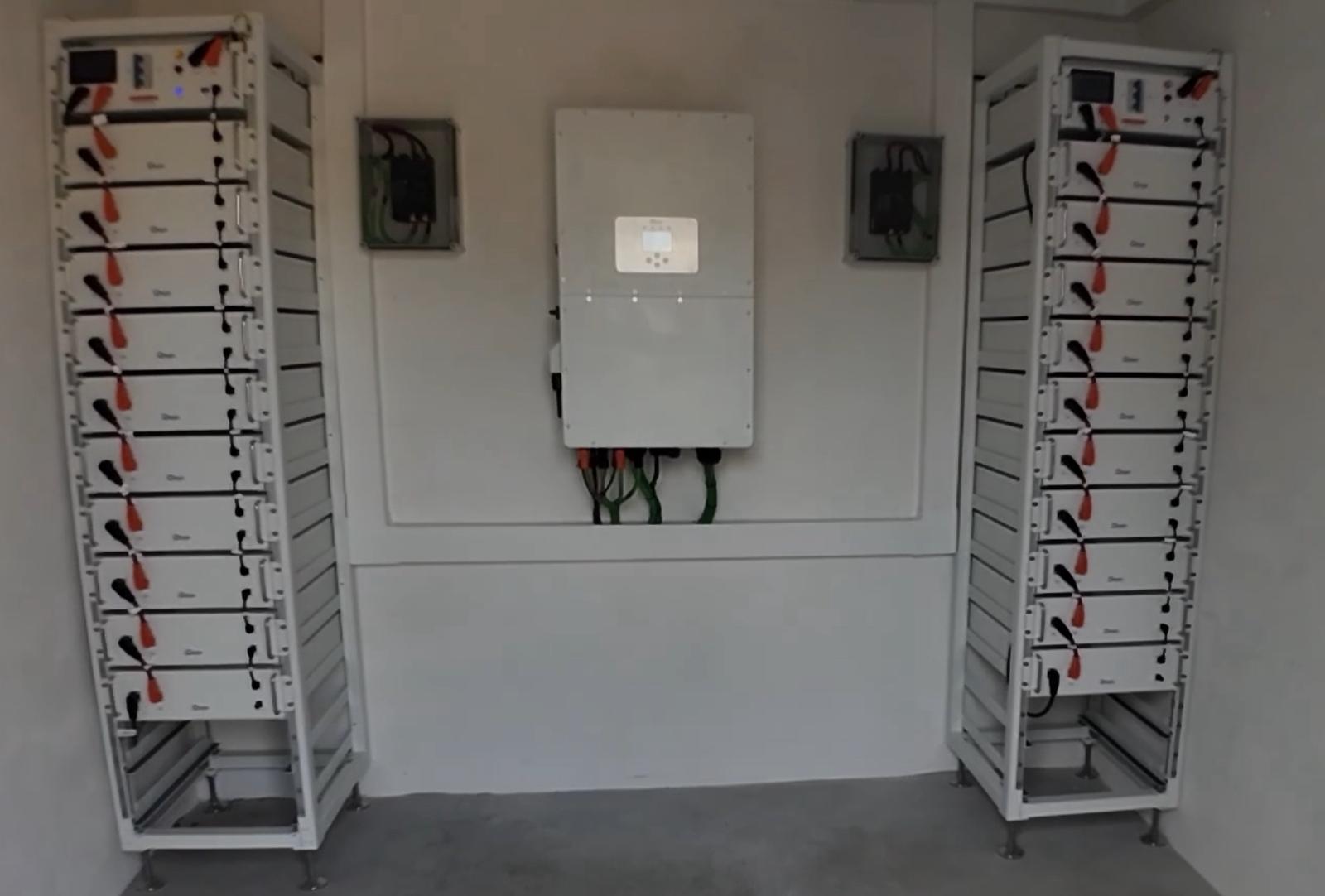
- 20× DEYE BOS-G Pro 5kWh LiFePO4 modules — 100kWh total storage capacity
- 2× floor-standing rack towers (10 modules per tower, 50kWh per rack) with independent 200A DC fusing
- DEYE three-phase hybrid inverter — grid-tied with full off-grid island mode capability
- 80kWh net usable daily discharge at 80% depth-of-discharge (DoD)
- 54kWp solar PV array paired — 98,000 kWh annual clean energy production
- DC bus design to IEC 62619: 150mm² main cables, tin-plated copper busbars, 500V DC isolation switch
- Split-bus commissioning: Rack 1 live 24h before Rack 2 paralleled in — zero downtime
- DEYE SolarmanPV remote monitoring — real-time SoC, charge/discharge, solar generation and grid data
- 10kWh emergency blackout reserve (10% SoC floor) — property protected against all grid outages
- Dedicated climate-controlled battery room — ambient temperature maintained 10°C–35°C for maximum LiFePO4 longevity
- Full REBT and AENOR certification — IEC 62619 compliant installation documentation
- 10-year DEYE battery warranty backed by LIT Electricians after-sales support
Our Installation Process
Step 1: Full 7-Day Load Audit with Three-Phase Metering
Before specifying a single battery module, we installed three-phase energy loggers on every major circuit: pool pump (7.5kW motor), underfloor heating system, air conditioning plant, irrigation pump, workshop supply, and the main household distribution board. Over 7 days we captured 15-minute interval data for total consumption, solar generation, grid import, and grid export. The data revealed a 268kWh average daily demand, with peak loads reaching 32kW in mid-morning when the pool pump, AC, and underfloor heating all ran simultaneously. Critically, the logging showed 41kWh of daily solar surplus being exported to the grid — energy being sold for €0.06/kWh and bought back at night for €0.32/kWh. This audit is why we specified 100kWh rather than 50kWh: a smaller battery would charge full by 11am on summer days, then export the remaining 8–10 hours of solar generation for almost nothing.
Step 2: Battery Sizing — Matching 100kWh to Winter Worst-Case Demand
Battery sizing for a rural finca in inland Málaga must account for the worst-case scenario: December and January, when solar irradiance drops to 3.2 peak sun hours per day and the underfloor heating runs continuously. Our calculations showed that on a typical January day, the 54kWp array generates approximately 173kWh — while the finca consumes 280kWh. The 100kWh battery bank bridges the 107kWh overnight gap without any grid import on 90% of January nights. At 80% depth-of-discharge, the DEYE BOS-G Pro modules deliver 80kWh of net usable storage per discharge cycle. With two full charge-discharge cycles possible on longer summer days, the system handles the full annual load profile. We modelled 12 months of generation vs consumption data and confirmed that 100kWh storage achieves 95% annual self-sufficiency — the threshold beyond which additional capacity delivers diminishing returns for this specific consumption profile.
Step 3: DC Bus Design and IEC 62619 Safety Compliance
With 20 battery modules across two rack towers operating on a 500V DC bus, the electrical design required careful cable sizing, fusing strategy, and earthing scheme. Craig, our Electrical Director, led the DC bus design: each tower operates as a 50kWh sub-bank with independent 200A DC fusing, allowing one rack to be isolated for maintenance while the other continues operating. All DC bus bar connections were specified to IEC 62619 — the international safety standard for stationary battery energy storage systems — with cable cross-sections sized at 150mm² for the main DC trunk to limit resistive losses to under 0.3% at full discharge current. The battery room was assessed for ventilation requirements: LiFePO4 chemistry is inherently safer than NMC or lead-acid and produces negligible off-gas under normal operation, but we installed a dedicated mechanical ventilation system to maintain room temperature between 10°C and 35°C — the optimal operating range for maximum DEYE battery cycle life. All work was signed off to REBT (Spanish Low Voltage Electrical Regulations) and AENOR certification.
Step 4: Split-Bus Commissioning — Zero Downtime for the Property
Commissioning a 100kWh battery system at a permanently occupied finca required a zero-downtime approach. We used a split-bus commissioning sequence: Rack 1 (50kWh, 10 modules) was energised, configured, and integrated with the DEYE inverter first, while Rack 2 remained de-energised. The inverter and DEYE SolarmanPV monitoring were brought online with Rack 1 running, verifying charge/discharge cycling, SoC accuracy, and inverter-to-battery communication over a 24-hour period. Once Rack 1 was confirmed stable, Rack 2 was paralleled in and the full 100kWh bank configured as a single storage pool. The DEYE inverter's battery management was then recalibrated to reflect the full 100kWh capacity: charge current limits, discharge rate curves, low-SoC protection threshold (set to 10%, reserving 10kWh as a hard blackout reserve), and grid fallback voltage threshold. Total commissioning time from first cable connection to full handover with SolarmanPV app configured on the client's phone: 14 hours across two days.
Results
See the installation scope and equipment below; no financial outcome is promised.
Project Video
Backed by Research
References for checking the proposed design. These sources do not certify this project's performance, savings, eligibility or commissioning records.
Battery safety is system- and installation-specific
LiFePO4 is not fireproof or free of thermal-runaway risk. Select equipment with appropriate safety documentation, protection, battery management and installation conditions. Do not puncture, overcharge or short-circuit a battery; a chemistry label does not establish safety under abuse.
IEC — battery safety standards ↗Check exact-model cycle life and warranty conditions
A laboratory cycle rating is not a guaranteed number of calendar years. Depth of discharge, temperature, throughput, retained-capacity criteria and operating limits matter. Confirm usable capacity and the written warranty for the quoted model.
Deye — model documentation ↗Backup requires a designed and commissioned arrangement
A hybrid inverter or battery does not automatically keep a property powered during an outage. Check supported loads, switching, earthing, protection and the manufacturer's backup specification. Transfer time and runtime are model- and load-dependent; critical medical or life-safety loads need specialist continuity planning.
BOE — REBT ↗The DC electrical design on a 100kWh installation is where you cannot cut corners. Twenty battery modules at 48V nominal arranged in two parallel strings generates fault currents that can reach 5,000A before the fuse clears — that is enough to vaporise undersized cable and cause a fire. We specified 150mm² cable throughout the DC trunk, independent 200A ANL fuses per rack tower, and a dedicated DC isolation switch rated for the full system voltage and current. The IEC 62619 standard was our baseline, but we went beyond it: the busbar connections are made with tin-plated copper bars rather than cable lugs to minimise connection resistance and thermal cycling fatigue. The earthing scheme was designed to ensure that any single ground fault on the DC bus would be immediately detected by the DEYE inverter's insulation monitoring function and trigger a safe shutdown. This level of electrical design is what separates a professional battery storage installation from an amateur one — and it is why LIT Electricians is the company to call for large-scale battery storage in Málaga province.

Work Completed
- 7-day three-phase load audit with 15-minute interval data logging across all major circuits
- Full annual generation vs consumption modelling confirming 100kWh sizing
- Supplied and installed 20× DEYE BOS-G Pro 5kWh LiFePO4 battery modules (100kWh total)
- Built and wired 2× floor-standing rack towers (10 modules per tower, 50kWh per rack)
- Installed DEYE three-phase hybrid inverter with full grid-tie and off-grid island mode capability
- DC bus design to IEC 62619: 150mm² main trunk cables, 200A ANL fuses per rack, tin-plated copper busbars
- Dedicated battery room preparation: mechanical ventilation, thermal management, and access door
- Split-bus commissioning — zero downtime for the occupied property over two days
- DEYE SolarmanPV remote monitoring: real-time SoC, charge/discharge rates, solar and grid data
- Low-SoC emergency reserve configured at 10% (10kWh hard blackout reserve)
- Full REBT and IEC 62619 certification documentation provided to client
- Client training on SolarmanPV app, battery care, and annual maintenance schedule
- 10-year DEYE battery warranty registered and backed by LIT Electricians after-sales support
Frequently Asked Questions
Related Services
LIT services in Alhaurín el Grande directly related to this work.
Add battery storage to keep your solar energy for the evening and stay powered through grid cuts in Alhaurín el Grande.
Custom-designed solar PV systems supplied and installed across Alhaurín el Grande and the surrounding area.
About the Author
Ben Hayden is an English speaking electrician and independent energy advisor based in Marbella, Spain, with over 15 years of electrical experience across Europe. He provides independent energy and electrical checks for overseas property owners and managers across the Costa del Sol — helping clients cut electricity bills, navigate Spanish regulations, and make confident decisions on solar PV, heat pump, EV charger and battery storage projects. Ben advises in plain English on projects where the paperwork is in Spanish and the stakes are high. His writing has appeared in ExpatArrivals, The Olive Press, Euro Weekly News, BuildingTalk and pv magazine.
Want a similar project?
Free consultation and no-obligation quote for Costa del Sol properties.
Quote ConfiguratorProject Details
- Location
- Alhaurín el Grande, Málaga
- Property Type
- Rural Finca (Large Private Estate)
- Completed
- March 2026
- Service
- Battery Storage
- Author
- Ben Hayden