Chint Consumer Unit + Auto-Reset RCDs, Alhaurín el Grande
Replacement Chint consumer unit with Circutor REC4 auto-reset RCDs in a finished villa in Alhaurín el Grande — 18 circuits, 8 RCD groups, brand-matched to existing Chint switchgear, designed as a defensive upgrade ahead of a planned 2028 full rewire.
 By Ben Hayden
Project Overview
The Challenge: Aged Consumer Unit, Outdoor Nuisance Trips, No Rewire Window — Until 2028
Replace a failing 25-year-old consumer unit on a finished, lived-in villa where a full rewire is impossible today but planned for the 2028 reform — and stop the outdoor and security nuisance trips that have been waking the family up every winter.
The Solution
The client owns a finished villa in Alhaurín el Grande — fully decorated, fully lived-in, on a 3-phase 230 V/400 V supply — with an existing Chint-branded electrical installation that the previous owner specified throughout. Over the past year the original consumer unit had become unreliable: nuisance trips on the outside lighting and security circuit during winter rain, a main switch that no longer felt mechanically positive, and a board that had been added to piecemeal over the years until the labelling no longer matched the circuits behind it. The client called us with a clear brief and an equally clear constraint. The brief: replace the consumer unit, restore safe and reliable protection across the whole property, and do it without trips that wake the family up at three in the morning when a wet weather seal lets a few drops of moisture into an outdoor PIR. The constraint: a full rewire — chasing every wall, lifting every floor, replastering and redecorating the entire villa — was not on the table. Not now. The property is finished, the family lives in it every day, and there is a major reform planned in roughly two to three years that will involve opening the structure anyway. Doing a full rewire today and then opening the same walls again in 2028 makes no sense for anyone. This case study explains the engineering decisions on a project where the brief is not 'rebuild from scratch' but 'make the existing installation as safe, reliable, and future-ready as it can be — and brand-match it cleanly to what is already there.' It covers why the client specified Chint (and what makes Chint a credible specification on a Spanish residential board), why we fitted Circutor REC4 self-reclosing RCDs on every one of the 8 RCD groups rather than mixing fixed and auto-reset devices, how the 18 final circuits were grouped across the 8 RCDs and balanced over the three phases L1, L2 and L3, and how the whole assembly was pre-built off the wall before a single live cable was disconnected from the existing supply.
Technical Specifications
- Finished villa, 3-phase 230 V/400 V supply, Alhaurín el Grande
- Existing wiring retained (full rewire deferred to client's planned 2028 reform)
- 18 circuits across 8 RCD groups, distributed across phases L1, L2 and L3 for balanced loading
- 8× Circutor REC4 self-reclosing 30 mA RCDs — one per RCD group (zero-trip-tolerance brief: every group, indoor and outdoor, is auto-reset)
- Chint NB1 four-pole main switch on top row
- Chint Type 2 surge protection device at origin per REBT ITC-BT-23
- 1.5 days on site for off-wall pre-build, changeover, and full test schedule
- Boletín Eléctrico issued covering scope of work executed
Our Installation Process
Why a Full Rewire Wasn't on the Table — Yet
The first conversation on a project like this is always about scope. The honest engineering answer to nuisance trips and an aged consumer unit on a 25-year-old installation is, in many cases, a full rewire to current REBT standards — new circuit conductors throughout, new outlet positions, a fresh boletín and CIE certificate, the lot. We had that conversation with the client. We also had the practical conversation that follows: a full rewire of a finished, plastered, painted villa means chasing every wall, lifting every tile, ripping out skirting, replacing flooring in the affected runs, and then a complete redecoration of every room the work touches. On a property of this size, the decoration alone — never mind the electrical labour — runs into the tens of thousands of euros. And critically, the family already has a major reform booked for the medium term: a kitchen rebuild, two bathrooms reconfigured, a structural opening between the living and dining rooms, and a complete redecoration. That reform will open most of the walls anyway, and is the natural and economic moment to pull a complete new wiring system through the structure. Doing it twice — once now, once in two years — would mean paying for the destructive work twice and living through the disruption twice. The right call was to scope today's work as a defensive upgrade: replace the consumer unit, modernise the protective devices, get the labelling and documentation correct, and make the existing wiring as safe and reliable as it can be — knowing that a full rewire is on the books for the next phase. That decision was put in writing, signed off by the client, and the new boletín will reflect the precise scope of work undertaken. Nothing was promised that we did not deliver, and nothing was concealed about what was deferred.
The Case for Auto-Reset RCDs — On Every Group, Not Just Outdoor
The single biggest pain point on the original installation — and the one the client described first — was the outside lighting and security circuit tripping during wet weather. The cause is well understood. Outdoor IP-rated enclosures, PIR sensors, gate motor housings, garden bollards and pool-area junction boxes all rely on rubber gaskets and sealed glands to maintain their IP54 or IP55 rating. Those gaskets degrade. UV from the Andalucían sun hardens them, the seasonal temperature swing between a 38°C summer afternoon and a 4°C winter night cycles them, and after ten or fifteen years they no longer compress as designed. The first heavy rain of the autumn finds the path of least resistance, a few drops of moisture cross the live conductor to earth somewhere outside, and the RCD upstairs trips — exactly as it should, because that is its job. The problem is not the RCD. The problem is that on a security circuit, an outside lighting circuit, or a refrigeration circuit, an unattended trip in the middle of the night is not an inconvenience — it is a safety failure. Cameras stop recording, the gate motor will not respond to the fob in the morning, and a freezer can be sitting at room temperature by breakfast. The engineering answer is an auto-reset RCD: a device that detects the trip exactly as a normal RCD does, isolates the circuit immediately, and then — after a programmed waiting period — automatically tests the line for a continuing fault and re-energises only if the fault has cleared. If the fault is persistent, the device locks out and stays off, exactly like a standard RCD. The client's brief was simple and uncompromising: zero overnight trips on any group, anywhere in the house, while the property bridges to its 2028 reform. So we specified Circutor REC4 self-reclosing RCDs on every one of the eight RCD groups — not just the obvious outdoor and security candidates, but every group, indoor and outdoor alike. The reasoning is economic as much as engineering: the cost premium of a REC4 over a fixed 30 mA RCD is small compared to a single after-hours call-out, and on a property with eighteen circuits across multiple zones it would be arbitrary to draw a line between 'circuits worth protecting against nuisance trips' and 'circuits not worth it'. With REC4 throughout, a transient fault on any circuit — a moisture incursion outside that dries within minutes, a vacuum cleaner brushing a worn flex indoors, an inrush spike from a fridge compressor — clears, the device tests the line, and the circuit comes back automatically without the family losing service. A fault that does not clear (a real wiring failure) still locks that group out exactly as a standard RCD would. The safety case is unchanged; the resilience case is significantly stronger; the cost differential is rounding error against the labour of the install. On the photographs, that is what the eight yellow Circutor service handles across every row of the board are showing.
Why Chint? Brand Specification, Compatibility, and the Facts
The client specified Chint as the brand for the new consumer unit and protective devices. The reasons were practical first: the rest of the property is already fitted out with Chint switchgear — sub-distribution boards in the pool plant room and garage, isolators on the AC outdoor units, and the spares the previous owner left in a labelled box in the garage are all Chint modules. Standardising the new main board on the same brand means a single set of spare MCBs and main switch poles covers the whole property, the visual finish across every consumer unit on the property is consistent, and a future electrician — ours or anyone else's — finds a coherent installation rather than a patchwork of three different manufacturers' modules. Beyond the practical case for matching what is already there, Chint is a credible specification on its own merits, and the fact that it is less familiar to homeowners than Schneider, ABB or Hager deserves a few facts. Chint Group was founded in 1984 in Wenzhou and is today the largest low-voltage switchgear manufacturer in the world by volume, with over 30,000 employees, manufacturing facilities on three continents, and annual group revenue exceeding USD 10 billion. The Chint Electric subsidiary is publicly listed on the Shanghai Stock Exchange. The NB1 modular MCBs we fitted carry IEC 60898-1 and EN 60898-1 certification and are KEMA tested at the Dutch independent laboratory — the same certification regime applied to every European brand on the same DIN rail. The breaking capacity of the residential range is 6 kA (Type C characteristic), the design life of the modular range is twenty-five years, and the manufacturer warranty on the protection devices is five years. The modules are built on the standard 18 mm-per-module DIN-rail pitch and are mechanically and electrically interoperable with Circutor, Schneider, Hager and ABB modules on the same rail — which is precisely how this installation works, with the Chint NB1 1P+N (double-pole, single-element) MCBs and a Chint NB1 four-pole main switch sitting on the same rail as the Circutor REC4 self-reclosing RCDs. Worth a word on the 1P+N MCB construction: each circuit MCB occupies two module slots on the rail, has one combined handle, and on trip opens both Live and Neutral of its circuit while sensing overcurrent on the Live conductor only. That two-pole construction is a deliberate specification choice for a board that is bridging to a 2028 rewire — when the destructive work begins, a future electrician can pull a single MCB and have that circuit's Live and Neutral both dead, isolating one room or one load completely without touching the upstream RCD group or the main switch and without taking the rest of the house off supply. Chint switchgear is specified in serious applications globally — utility distribution, datacenter critical power, large commercial buildings — and is listed on multiple European wholesale catalogues including those of major Spanish electrical distributors. The brand is not a downgrade from a European-name alternative. It is a manufacturer with the volume, the certification, and the manufacturing rigour that justifies a specification, and on this project it is also the brand that lets us hand the client back a property where every consumer unit looks and operates the same way.
Distribution Design: 18 Circuits, 8 RCD Groups, One Surge Device
The existing wiring presented eighteen circuits to the consumer unit position. Before any new device went on the rail, every one of those circuits was identified, traced back to its origin, tested for continuity end-to-end and for insulation resistance to earth, and labelled at both the consumer unit end and the load end with a permanent Brady label. Three circuits that had been added piecemeal over the years and were no longer in use were positively identified, tested as isolated, and removed from the schedule. The remaining eighteen were then grouped across eight RCDs. The grouping is not arbitrary. The principle is straightforward: a fault on any single RCD must never simultaneously knock out two essential systems. Lighting and sockets in the same room are split across different RCDs, so a sockets fault never plunges a room into darkness. The kitchen lighting and the kitchen sockets are on different RCDs, for the same reason. The fridge-freezer radial is on its own dedicated RCD so that any nuisance fault elsewhere in the house cannot defrost the contents. Every one of the eight RCD groups is a Circutor REC4 self-reclosing 30 mA device — visible on the photographs by the yellow service handle on every group — and the eight groups are then balanced across phases L1, L2 and L3, which are clearly labelled on the chassis above each row. Phase balancing matters: it keeps the line currents on the three poles of the main switch broadly equal under normal load, which avoids overloading any one phase, keeps the neutral current low, and presents a clean power factor back to the supply. The internal lighting circuits, the indoor socket rings, the kitchen heavy loads (oven, hob, dishwasher each on a dedicated Type C 16 A or 20 A MCB), the AC indoor unit, the water heater, and the underfloor electric heating in the bathrooms are distributed across these eight groups according to which physical room they serve and which phase carries the rest of that zone. Above all of this, on the top row of the board next to the four-pole Chint NB1 main switch, sits a Chint Type 2 surge protection device, sized for the 3-phase 230 V/400 V supply that serves the property. SPDs at the origin of the installation are now mandatory under the latest revision of REBT ITC-BT-23 for domestic installations of this category, and the device protects the entire downstream installation — including the AC inverter electronics, the fridge-freezer compressor electronics, the home network gear and any computer equipment — against the over-voltage spikes that arrive with the lightning storms that hit Alhaurín every September. The hand-written legend taped inside the door, photographed in the gallery on this page, is the final document the client sees: every circuit numbered, every RCD numbered, every load identified in plain language. That legend is laminated and re-fitted permanently to the inside of the cover at the close of the project, and a digital copy goes with the boletín into the client's project file.
Off-Wall Pre-Build, Calibrated Termination, and Testing Before Energising
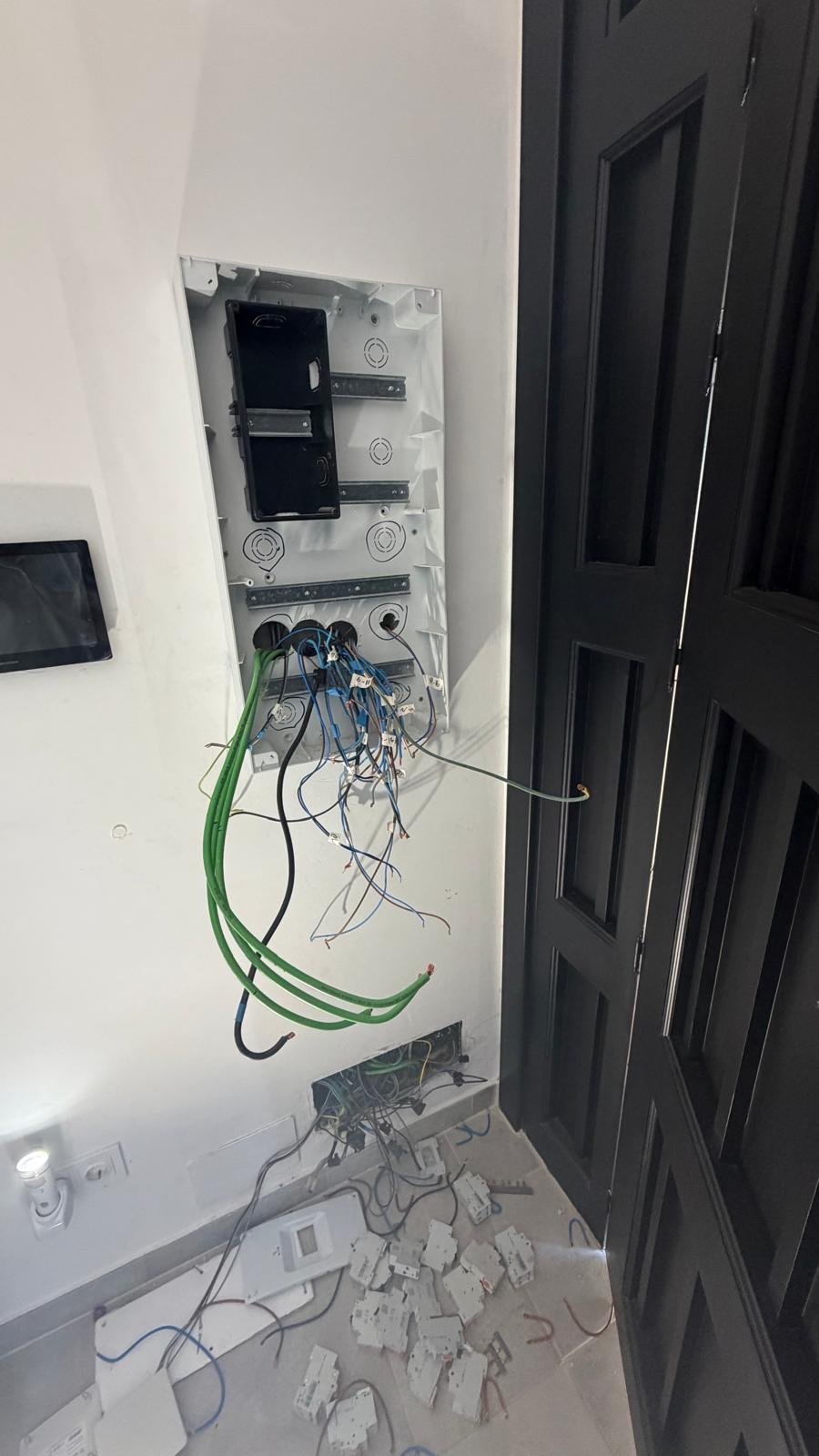
The previous consumer unit on the wall stayed live and in service while the new one was being assembled. That is the whole point of the off-wall pre-build approach: the family does not lose power, the freezer keeps running, the wifi does not drop, and the only moment the supply is interrupted is the changeover window itself, which is measured in hours rather than days. The new Chint enclosure was mounted on a workbench and built up in a logical sequence. First the four-pole Chint NB1 main switch and the Chint Type 2 surge device on the top row, hard-wired to the incoming and outgoing busbars across the three phases L1, L2 and L3 plus neutral. Then the eight Circutor REC4 self-reclosing 30 mA RCDs in their final positions on the rail — each labelled RCD 1 through RCD 8 with the load they protect, and balanced across the phases as set out in the previous section. Then the eighteen Chint NB1 1P+N MCBs distributed below their respective RCDs — each MCB two modules wide on the rail, switching both Live and Neutral when tripped — each circuit numbered 1 through 18 to match the legend. The internal flying leads — between RCDs and MCBs, and between MCB outputs and the terminal blocks — were cut to length, ferruled where the cross-section required it, and torqued to the manufacturer's specification with a calibrated torque screwdriver: 1.2 Nm on the modular terminals, 2.5 Nm on the main switch terminals. Calibrated torque is one of those details that is invisible in the finished result and decisive in the next twenty years of service. Under-tightened terminals are the leading cause of consumer unit fires in domestic installations across Europe; over-tightened terminals damage the conductor and produce the same eventual failure. A torque screwdriver is the only correct way to make a modern modular termination. With the assembly complete, the existing supply was isolated at the meter, the old enclosure stripped from the wall, the new Chint enclosure mounted in its place, the incoming tails brought across and terminated to the main switch, and the eighteen circuits made off to the labelled outgoing terminals. Before re-energising, every circuit was tested: insulation resistance at 500 V to PE (every circuit above 1 MΩ — most well above 100 MΩ), continuity on every conductor, polarity on every outlet, and RCD trip-time measured at 30 mA, 5 × rated and 0.5 × rated with a calibrated multifunction tester. Each Circutor REC4 was then put through one full simulated trip-and-reclose cycle to verify the auto-reset behaviour. Only after every test produced a passing result was the supply restored, the cover refitted, and the legend taped to the inside of the door. The boletín issued under the project covers the new consumer unit, the protective devices, and the test results.
Results
New 3-phase Chint consumer unit installed and certified, all 18 circuits protected by 8 Circutor REC4 self-reclosing RCDs and balanced across phases L1, L2 and L3, every circuit tested and labelled, surge protection added at origin, full Boletín Eléctrico issued — and a clean foundation for the planned 2028 full rewire.
Project Location
Installation in Alhaurín el Grande. We cover the whole of Málaga province.
The interesting engineering call on this job wasn't the consumer unit itself — that's straightforward — it was getting the scope right. The honest answer to a 25-year-old installation with nuisance trips is, in many cases, a full rewire. But the client has a major reform booked for 2028 that opens most of the walls anyway. Doing a rewire today and ripping it back out in two years would have meant paying twice for the same destructive work. Instead we scoped a defensive upgrade: a brand-new 3-phase Chint consumer unit, modern protective devices — Circutor REC4 self-reclosing RCDs on every one of the eight RCD groups, because the client's brief was zero overnight trips, full stop — surge protection at origin, full test schedule, and a clean Boletín. The wiring stays as it is until 2028, when it gets done properly as part of the wider reform. That conversation, agreed in writing with the client at the start, is what good electrical work looks like when the brief is to bridge between today and a planned future — not to pretend that ignoring the future is somehow more thorough.

On Spanish residential boards there's still a perception that Chint is a budget choice and the European brands are the serious ones. The numbers say something different. Chint is the largest low-voltage switchgear manufacturer in the world by volume, the NB1 modular range carries the same IEC 60898-1 and EN 60898-1 certification as every other module on the rail, and KEMA — the same independent Dutch laboratory that tests Schneider, Hager and ABB — tests it too. The breaking capacity is 6 kA, the design life is twenty-five years, and the modules are built on the standard 18 mm-per-module DIN-rail pitch, which is exactly why we can sit Chint NB1 1P+N MCBs and Circutor REC4 self-reclosing RCDs on the same rail in the same enclosure. On this job the client specified Chint to match what was already installed across the rest of the property, and that's the right reason to specify a brand: a coherent installation, one set of spares for the whole house, and a future electrician who walks in to find one manufacturer's modules on every board they open.
Work Completed
- On-site survey and circuit identification: 18 active circuits traced, tested for continuity, and labelled at both ends; 3 disused circuits identified, isolated, and removed from the schedule
- Scope of work agreed in writing with client: defensive consumer unit replacement and protective device upgrade today, full rewire deferred to the planned 2028 reform
- New Chint enclosure specified to brand-match existing Chint switchgear in pool plant room, garage sub-board, and AC isolators
- Chint NB1 four-pole main switch fitted on top row, sized for the property's existing 3-phase 230 V/400 V supply
- Chint Type 2 surge protection device fitted at origin of installation per REBT ITC-BT-23
- 8× Circutor REC4 self-reclosing 30 mA RCDs across the board, one per RCD group, balanced across phases L1, L2 and L3 — every group is auto-reset (no fixed RCDs) per the client's zero-trip-tolerance brief
- 18× Chint NB1 1P+N (double-pole, single-element) MCBs Type C 6 kA on dedicated outgoing terminals — each MCB two modules wide on the rail, switching both Live and Neutral when tripped; ratings selected per circuit (typical 10 A lighting radials, 16 A socket rings, 20 A kitchen heavies, 25 A water heater)
- Off-wall pre-build of complete chassis on workbench; existing supply remained live until changeover window
- All internal flying leads cut to length, ferruled to manufacturer specification, and torqued with calibrated torque screwdriver (1.2 Nm modular, 2.5 Nm main switch)
- Old consumer unit removed; new Chint enclosure mechanically fixed to wall in same position
- Incoming tails terminated to new main switch; 18 outgoing circuits made off to labelled outgoing terminals
- Insulation resistance test at 500 V to PE: every circuit above 1 MΩ; majority above 100 MΩ — full results recorded
- Continuity tested end-to-end on every circuit conductor; polarity verified at first outlet on every ring
- RCD trip-time measured on every device at 30 mA, 5× rated, and 0.5× rated with calibrated multifunction tester — all within REBT limits
- Circutor REC4 self-reclosing cycle tested on every auto-reset device — full trip, isolation, line check, and reclose verified
- Hand-written circuit legend produced on site, laminated, and permanently fitted to inside of cover door; digital copy retained for client file and Boletín
- Boletín Eléctrico issued covering scope of work executed; CIE update scheduled to follow the 2028 rewire phase
Photo Gallery
Related Services
LIT services in Alhaurín el Grande directly related to this work.
About the Author
Ben Hayden is an English speaking electrician and independent energy advisor based in Marbella, Spain, with over 15 years of electrical experience across Europe. He provides independent energy and electrical checks for overseas property owners and managers across the Costa del Sol — helping clients cut electricity bills, navigate Spanish regulations, and make confident decisions on solar PV, heat pump, EV charger and battery storage projects. Ben advises in plain English on projects where the paperwork is in Spanish and the stakes are high. His writing has appeared in ExpatArrivals, The Olive Press, Euro Weekly News, BuildingTalk and pv magazine.
Want a similar project?
Free consultation and no-obligation quote for Costa del Sol properties.
Quote ConfiguratorProject Details
- Location
- Alhaurín el Grande, Málaga
- Completed
- April 2026
- Service
- Electrical
- Author
- Ben Hayden