
6kW DEYE Solar — Benahavís Golf Community
A 6kW hybrid solar installation on a comunidad de propietarios townhouse roof — navigating AGM approval, string design, CAU registration, and ICIO tax reduction in Benahavís.
 By Ben Hayden
Project Overview
The Challenge: Comunidad de Propietarios Approval Required
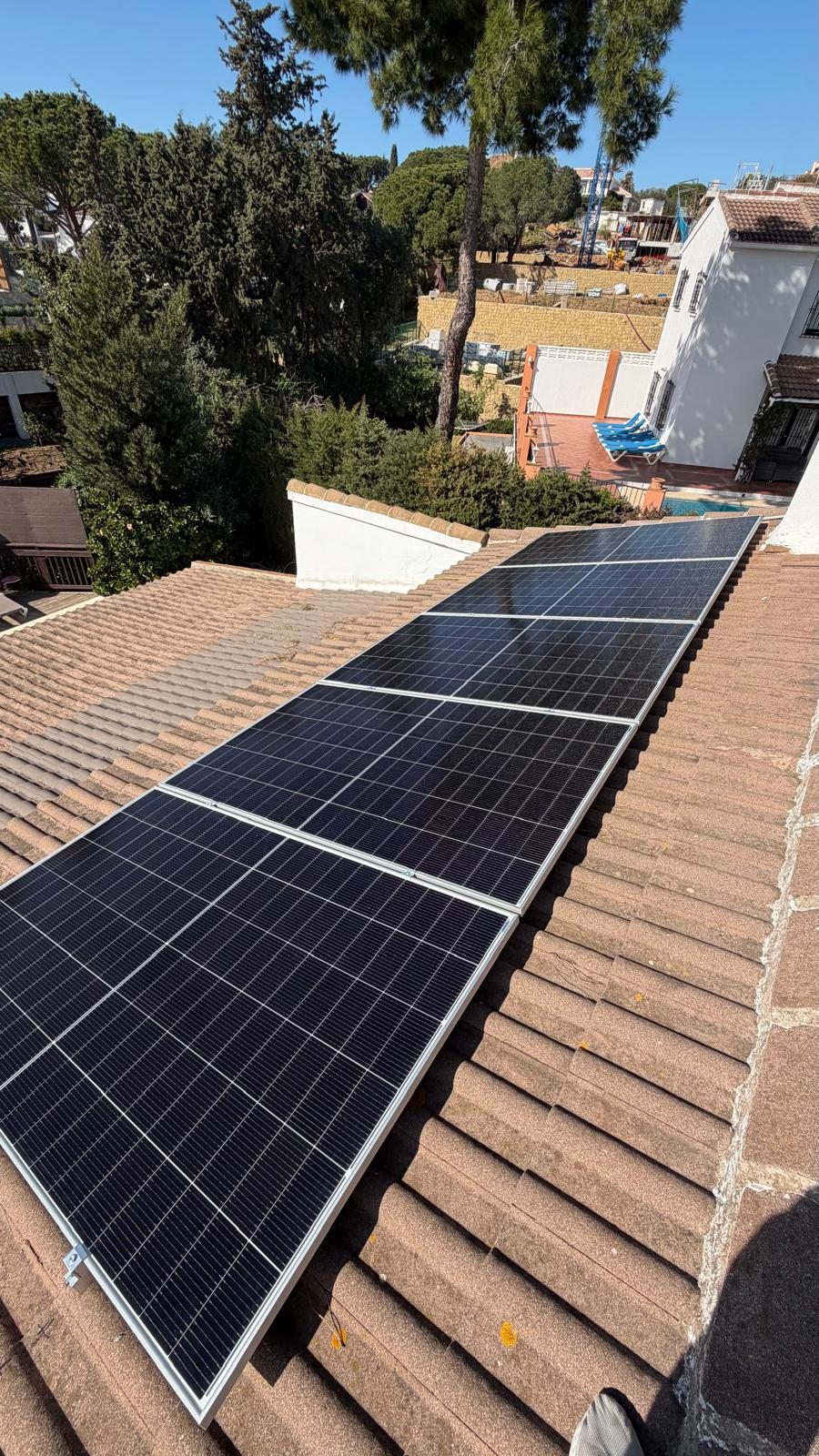
The central challenge here had nothing to do with the roof pitch or the panel count. It was the comunidad de propietarios. The roof of this townhouse is common property under the Ley de Propiedad Horizontal, which means the community of owners has a legal say over what goes on it. A lot of clients don't realise this until we sit down and explain it, and a few discover it at the wrong moment — after they've already bought panels. We needed the AGM to vote. Under Article 17.4 LPH, energy-saving installations require a 3/5 majority — not a unanimous vote, as people often assume. But you still have to show up with the right paperwork. We commissioned a structural report from a registered aparejador to confirm the roof trusses could carry the additional load (12 panels at 24.9kg each plus roughly 90kg of aluminium racking — about 390kg in total, spread across six mounting rails). We also drew up a cable route plan demonstrating that every centimetre of DC cabling would run through the client's own private terrace access hatch, not through communal risers or shared electrical infrastructure. The AGM voted eight in favour, one against. The dissenting owner cited aesthetics. That's noted in the acta, but under LPH 17.4 it carries no legal weight as a blocking vote. The other issue was a large mature pine tree to the east of the building — visible in the site photos. It creates shade on the easternmost panels from around 09:00 to 10:30 in December. We dealt with this by putting those panels on a dedicated MPPT input so that partial shading on the east string doesn't drag down the performance of the unshaded west string.
The Solution
Most of our Benahavís solar jobs are large standalone villas with a single owner making all the decisions. This one was different from the moment the client called. The property was a townhouse in one of the golf communities west of the village, and the roof belonged to the community — not the client. That changes everything about how a job gets started. The system itself is straightforward enough: 12 × 500W monocrystalline half-cut panels, two strings of six, feeding into a DEYE SUN-6K-SG03LP1-EU single-phase hybrid inverter. Six kilowatts on a south-facing terracotta tile roof, portrait-mounted in two clean rows. You can see from the photo exactly what we were working with — the forested hills behind, the terracotta rooftops of the neighbouring townhouses below, and the pine trees to the east that became part of the engineering conversation. Benahavís sits at around 200 metres above sea level, which gives it a slightly different microclimate from the coast. It's marginally more sheltered from the summer sea haze, but also occasionally mist-covered in winter mornings. PVGIS data for the site coordinates — 36.52°N, 5.04°W — puts the annual irradiance at around 1,750 kWh per kilowatt-peak. That's a touch lower than what you'd see on a south-facing Costa del Sol seafront, but still very good solar country. With 6kW of panels at that yield, we projected 10,500 kWh per year in generation. The household's annual consumption was running at around 15,400 kWh. So this system, with sensible usage habits and a bit of scheduling, offsets roughly 68% of their electricity. The maths works out to around €1,512 per year in savings — partly from avoided purchases at the retail rate, partly from surplus compensation paid by Endesa under the autoconsumo con compensación simplificada tariff. At a total installed cost in the €9,000–€10,500 range, we're looking at a payback of around 6.5 years on a system that should comfortably last 25. The DEYE SUN-6K-SG03LP1-EU was specified partly for its battery-ready architecture. The client wasn't committing to batteries yet, but they mentioned it — and once somebody's mentioned batteries, we'd rather put in a hybrid inverter now than replace a grid-tied inverter in two years' time.
Technical Specifications
- DEYE SUN-6K-SG03LP1-EU 6kW single-phase hybrid inverter (97.6% peak efficiency, dual MPPT 90–425V, battery-ready 40–60V LV)
- 12× 500W Tier-1 monocrystalline half-cut cell panels (6kW total array, two strings of 6)
- String voltage: Vmpp 189.6V per string — MPPT sweet spot; cold Voc 239.6V, under 500V max
- Coplanar aluminium rail mounting with stainless steel tile hooks — no roof membrane penetration
- AC/DC protection board: 15A DC string fuses, Type II SPD both sides, 25A Type A 30mA RCBO
- Endesa CAU self-consumption registration — simplified surplus compensation tariff
- Comunidad de propietarios AGM resolution obtained (Article 17.4 LPH, 8/9 majority)
- Boletín Eléctrico and declaración responsable filed with Ayuntamiento de Benahavís
Our Installation Process
Survey, Structural Check, and the Comunidad Vote
The first visit was really two surveys in one. We needed to assess the roof technically and also understand the legal situation well enough to advise the client on what the comunidad process would involve. On the technical side: the roof is a traditional Spanish clay tile construction, pitched at approximately 17°, south-facing with a slight westward skew — maybe 5 degrees off true south. That's fine; it costs a fraction of a percent in annual yield. We ran the site coordinates through PVGIS (36.52°N, 5.04°W) and modelled the shade horizon. The pine tree to the east shows up clearly: it causes around 3% annual yield loss on the east string across the year, concentrated in the winter mornings. Manageable, and addressable through string separation. The roof load calculation was straightforward — 12 panels at 24.9kg, plus racking at around 90kg, gives roughly 390kg spread across six mounting rails. The aparejador's report confirmed the existing timber structure could take it without reinforcement. The grid side was clean too: single-phase supply, 5.75kW contracted power, no upgrade needed for a 6kW PV system with net metering. Then came the comunidad conversation. Most clients assume getting neighbours to agree is the hard part. It often isn't — it's the preparation. You turn up to an AGM without a structural report and a proper cable route plan, and you've given objectors something to point at. We came with everything documented. The vote took about forty minutes.
Why We Chose the DEYE SUN-6K-SG03LP1-EU
The client mentioned batteries during the survey visit — not as a firm plan, more as a 'maybe in a couple of years'. That one comment shaped the inverter choice. If you know batteries are a possibility, specifying a standard grid-tied inverter and then replacing it when the batteries arrive costs more in the long run than just starting with a hybrid. So we specified the DEYE SUN-6K-SG03LP1-EU. We did look at the alternatives. The Fronius Primo 6.0-1 is an excellent inverter — probably the most reliable single-phase unit we've used over the years — but it has no battery terminals, it costs around €800 more at current pricing, and if the client does add storage, it would need replacing entirely. The Goodwe GW6000-EH is a genuine contender; our only slight hesitation is that its MPPT floor sits at 100V rather than 90V, which gives you a marginally narrower operating window in low-light conditions. The Solis RHI-6K-48ES-5G was also on the shortlist. We've used Solis on plenty of jobs and it performs well. The deciding factor was that this client had specifically mentioned DEYE batteries as something they were interested in. With a DEYE inverter and DEYE batteries, the BMS communication is native — no third-party protocol bridging, no compatibility question marks. That's worth something. The SUN-6K itself is a well-specified unit. Peak efficiency sits at 97.6%, European weighted efficiency at 96.5% — both solid numbers for a 6kW class inverter. The MPPT range runs from 90 to 425 volts, with an absolute maximum input of 500V and a maximum current of 13A per MPPT channel. It runs two independent MPPT inputs, one string each. Battery side takes 40 to 60 volts — 48V nominal low-voltage chemistry — and handles up to 100A charge and discharge current, so it'll pair with any 48V LiFePO4 bank up to about 5kWh without breaking a sweat. It weighs 15kg, rates to IP65, and is CE marked to EN 50549 and VDE-AR-N 4105. For a townhouse installation going on an interior wall in a temperate climate, that's more than adequate.
Designing the Strings and the Protection Scheme
The string design sounds simple when you say it quickly — six panels on each of two MPPT inputs — but it's worth showing the working, because this is where installations go wrong when people just copy a configuration without checking the numbers. The 500W panels we used carry a Voc of 37.54V at standard test conditions and a Vmpp of 31.60V. Six panels in series gives a maximum power point voltage of 189.6V and an open-circuit voltage of 225.2V. The DEYE SUN-6K's MPPT window runs from 90 to 425 volts, so 189.6V sits comfortably in the middle — that's the ideal operating range, not squeezed against either limit. But you can't just check the STC voltage. Panels produce higher voltages in cold conditions, and inverters have hard limits. Benahavís record lows run around 3°C. Taking that as our worst-case ambient and applying the panel's temperature coefficient of −0.29%/°C from the STC reference of 25°C gives a correction factor of 1.0638. Worst-case string Voc comes out at 225.2 × 1.0638 = 239.6V. That's well under the inverter's 500V absolute maximum. The maths checks out in both directions. For the DC cabling we used 4mm² H1Z2Z2-K single-core solar cable, rated to 600V DC — standard for residential PV in Spain. Each string gets its own 15A fuse in the combiner box. The string short-circuit current is 13.93A; the fuse sizing formula of Isc × 1.25 × 1.25 gives a maximum of 21.8A, so 15A falls within the protective range. Type II surge protection devices on both the DC and AC sides, because coastal Andalucía gets enough late-afternoon storms in summer that SPD is worth having. AC protection is a 25A Type A 30mA RCBO — Type A rather than the cheaper AC-only type, because PV inverters can produce smooth DC fault components that AC-only devices won't detect. The AC cable from inverter to consumer unit is 6mm² H07V-K over a 14-metre route; voltage drop calculates out at just under 1.5%, which is within the REBT limit.
Installation Day, CAU Registration, and Handover
We did the installation over two days. The first morning was all tile hooks — individual stainless steel hooks slid up under each terracotta tile, no cement, no drilling through the membrane. Every tile comes back down after the hook goes in, so you can't tell from above that anything's there until the rails appear. Aluminium rails went on in the afternoon, levelled and torqued. Second day: panels up, DC cable run along the roof ridge in UV-rated conduit, down through the terrace access hatch that we'd mapped in the comunidad documentation, through the cavity wall and across to the inverter location. We'd spent more time than usual planning that cable route — drawn it three times before the AGM — and it showed. No improvising on the day, no communal areas touched. The inverter went on the interior wall, the AC protection board next to it, and then the final connection to the consumer unit. The commissioning run at 14:00 on the second day showed 4.8kW peak output. It was partly cloudy, so that number is encouraging rather than definitive, but it confirmed the system was working correctly and the inverter was seeing both strings. CAU registration with Endesa went in online the morning after installation. We got the CAU number back in 11 working days — slightly faster than the usual two-week window. The Boletín Eléctrico was completed and submitted to the Delegación de Industria on commissioning day. On the Ayuntamiento side, the declaración responsable for the works — which came in under the €30,000 threshold for a minor works license — was filed the same week. Benahavís applies a 50% ICIO discount for energy-efficiency installations under its local fiscal ordinance. On a declared works value of around €10,000, the standard ICIO at 3.5% would be €350; with the discount it came to €175. We handle the declaración responsable paperwork as part of the installation — clients don't need to involve a gestor for this part. The owner got the DEYE SolarmanPV app set up on their phone before we left, a laminated reference card explaining the inverter's LED fault codes, and a commissioning summary with the annual production target of 10,500 kWh and the next recommended service date.
Results
See the installation scope and equipment below; no financial outcome is promised.
Project Location
Installation in Benahavís, Málaga. We cover the whole of Málaga province.
Backed by Research
References for checking the proposed design. These sources do not certify this project's performance, savings, eligibility or commissioning records.
Estimate solar yield for the actual site
Annual generation depends on location, orientation, tilt, shading and system losses. An irradiance figure is not a guaranteed yield per installed kilowatt. State the assumptions and compare the estimate with the property's consumption.
European Commission — PVGIS ↗Check the applicable self-consumption arrangement
RD 244/2019 regulates administrative, technical and economic conditions for self-consumption. Export compensation is subject to the applicable arrangement and contract; exported energy is not automatically valued at the retail import price.
BOE — RD 244/2019 ↗Tax relief needs separate eligibility checks
Do not assume solar qualifies for an income-tax deduction or a standard municipal IBI discount. Check current AEAT conditions and the property's municipal ordinance, required evidence, dates and application process before including an incentive in a budget.
Agencia Tributaria — current tax guidance ↗People ask me what the hardest part of a townhouse solar job is. Most of the time it isn't the roof angle or the string voltage or even the grid connection paperwork — it's the cable route. On this job in Benahavís, the inverter had to live inside the owner's flat and every metre of DC cable between the panels and that inverter had to stay within the owner's private curtilage. The roof is communal. The stairwell is communal. The facade risers are communal. We designed the route three times before we found one that worked: down from the roof through the owner's private terrace access hatch, across the ceiling void, and into the inverter room through the owner's internal partition wall — never touching a communal riser, never requiring the community's permission for anything beyond the panel mounting itself. That's the kind of constraint that doesn't appear in an inverter specification or a panel datasheet, but it's what determines whether an installation actually gets built.

Work Completed
- Site survey, PVGIS shade analysis (36.52°N, 5.04°W), and roof structural load assessment
- Comunidad de propietarios AGM resolution obtained (Article 17.4 LPH, 8 of 9 owners in favour)
- Declaración responsable filed with Ayuntamiento de Benahavís; ICIO paid at 50% energy-efficiency rate
- 12 stainless steel tile hooks installed with no membrane penetration
- Coplanar aluminium rail system fixed to roof structure
- 12× 500W monocrystalline panels mounted and torqued to spec
- 4mm² H1Z2Z2-K DC solar cable routed in UV conduit along ridge to terrace access hatch
- DEYE SUN-6K-SG03LP1-EU inverter mounted on interior wall and commissioned
- AC/DC protection board installed: 15A string fuses, Type II SPD both sides, 25A 30mA Type A RCBO
- 6mm² H07V-K AC cable run from inverter to consumer unit (14m, voltage drop < 1.5%)
- Endesa CAU registration completed — CAU number confirmed in 11 working days
- Boletín Eléctrico completed and submitted to Delegación de Industria
- DEYE SolarmanPV app configured; commissioning sheet and LED fault-reference card handed over
- Test generation run: 4.8kW peak output confirmed at 14:00 commissioning day (partial cloud)
Frequently Asked Questions
Related Services
LIT services in Benahavís, Málaga directly related to this work.
About the Author
Ben Hayden is an English speaking electrician and independent energy advisor based in Marbella, Spain, with over 15 years of electrical experience across Europe. He provides independent energy and electrical checks for overseas property owners and managers across the Costa del Sol — helping clients cut electricity bills, navigate Spanish regulations, and make confident decisions on solar PV, heat pump, EV charger and battery storage projects. Ben advises in plain English on projects where the paperwork is in Spanish and the stakes are high. His writing has appeared in ExpatArrivals, The Olive Press, Euro Weekly News, BuildingTalk and pv magazine.
Want a similar project?
Free consultation and no-obligation quote for Costa del Sol properties.
Quote ConfiguratorProject Details
- Location
- Benahavís, Málaga, Málaga
- Property Type
- Private Townhouse, Benahavís Golf Community
- Completed
- March 2026
- Service
- Solar
- Author
- Ben Hayden
Related Projects
Solar Panels Rescued in Mijas — Wind Damage Emergency & Proper Reinstallation
Panels safe & properly reinstalled
Villa Solar + Battery - Marbella
See the installation scope and equipment below; no financial outcome is promised.
Off-Grid Solar System - Estepona Hills
See the installation scope and equipment below; no financial outcome is promised.