
Solar Array Extension — 6× 500 W Panels on Deye 8 kW Hybrid, Mijas
3.0 kWp solar extension on a steep Mijas hillside — six 500 W mono PERC panels on a bespoke hot-dip galvanised steel A-frame under the main deck, dropped straight into the spare MPPT of the existing Deye SUN-8K-SG04LP3 hybrid inverter. No second inverter, no new grid connection, only a CAU update.
 By Ben Hayden
Project Overview
The Challenge: Existing Solar Generation No Longer Covers Heat Pump + Second AC Zone Loads
Extend an existing solar installation on a Mijas hillside villa where the rooftop is fully built out and the only available solar-facing area is a steep slope under the main wooden deck — using the spare MPPT of the existing Deye 8 kW hybrid inverter to avoid the cost of a second inverter, and engineering a galvanised steel structure that survives twenty-five years of Andalucian weather on a 30° hillside.
The Solution
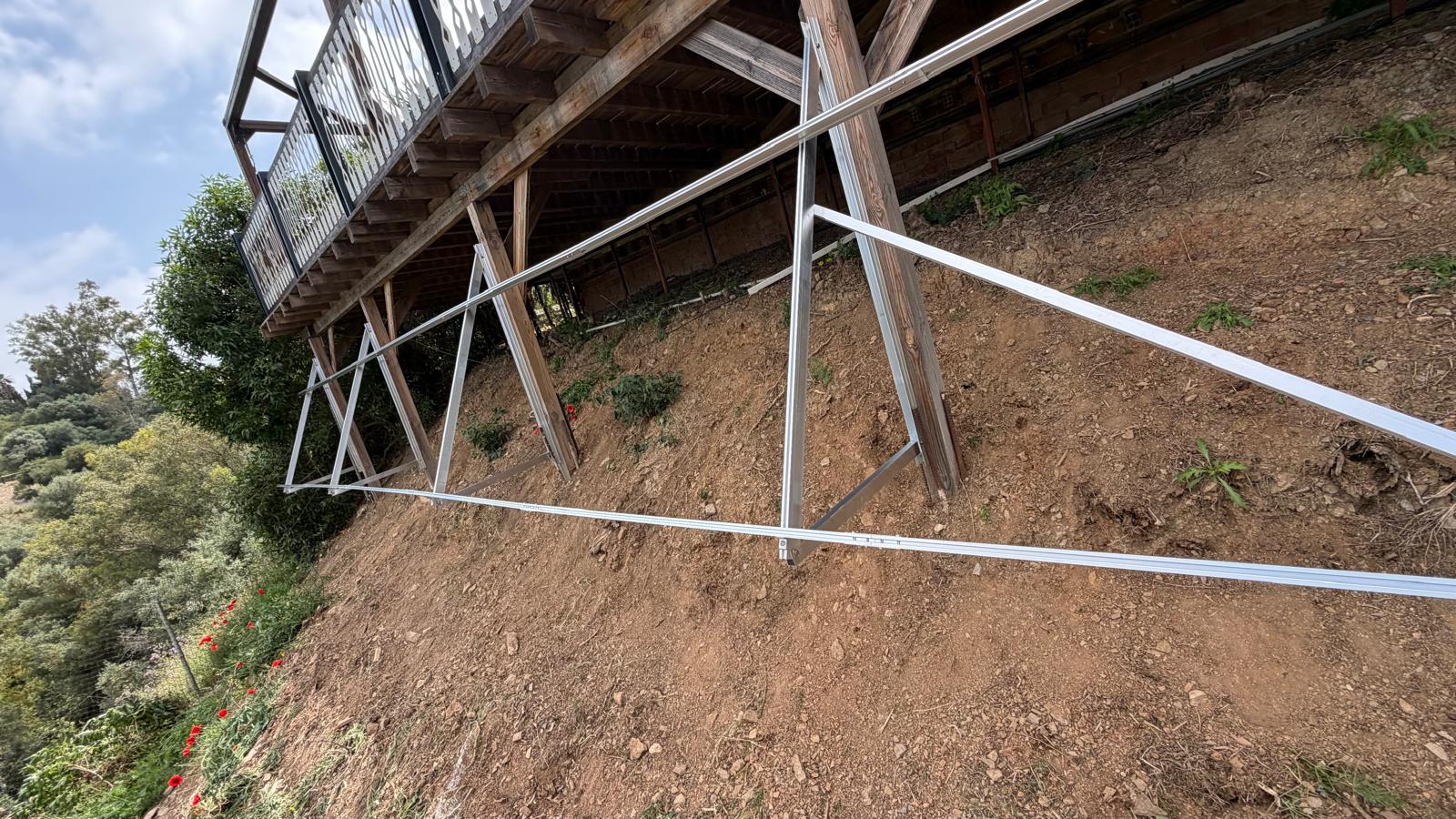
The client owns a hillside villa in Mijas built on a steep south-west-facing slope. The original solar installation — fitted two years ago by another installer — paired a 3-phase Deye SUN-8K-SG04LP3 hybrid inverter with a modest rooftop array. The inverter has been working faultlessly, the monitoring data is clean, and the consumption profile of the house has grown: a heat pump went in last winter, and a second air-conditioning zone was added during the summer. Generation no longer covers consumption. The client called us in to extend the array. The original installer had specified an 8 kW inverter with deliberate headroom — the Deye SUN-8K-SG04LP3 will accept up to 10.4 kW of PV on its DC side across two MPPTs (maximum 12.5 A short-circuit current per MPPT, 500 V open-circuit), and the existing rooftop string used only one of the two MPPTs and only a fraction of the available DC capacity. That headroom is the entire reason this extension makes economic sense: adding panels into the spare MPPT input means more generation without the cost of a second inverter, without changing the hybrid storage architecture, and without re-doing the grid-connection paperwork from scratch — only a CAU update to reflect the new total kWp. The rooftop was already built out and there was no mechanically sound additional roof area with the right pitch and orientation. The site engineering question was therefore where to put the extension. The answer the property gave us was the south-facing area directly underneath the main wooden deck on the lower side of the villa, where there is a clear view to the sky between roughly 9 am and 5 pm in winter and dawn-to-dusk in summer. The slope under that deck falls away sharply on a typical Mijas hillside gradient, and the only practical way to mount panels there in a way that survives twenty-five years of Andalucian sun, winter rain and the occasional Levante gust is a bespoke hot-dip galvanised steel A-frame structure built off the existing reinforced concrete columns and the bedrock below. This case study covers why the inverter headroom made the extension the right economic call, why we built a custom galvanised frame rather than buying off-the-shelf rails, and how the 3.0 kWp extension was electrically sized to drop straight into the spare MPPT input on the existing Deye inverter without changing a thing on the house side of the wiring.
Technical Specifications
- Hillside villa, Mijas, south-west aspect under main wooden deck
- Existing inverter: Deye SUN-8K-SG04LP3 3-phase hybrid (8 kW AC, 10.4 kW PV max, 2 MPPTs)
- MPPT 2 previously unused — existing rooftop string sits on MPPT 1, unchanged by this work
- Extension: 6× 500 W mono PERC panels = 3.0 kWp, single series string
- String specs: Voc ~300 V STC (~333 V worst-case cold), Isc ~13.5 A — within MPPT envelope (500 V / 12.5 A nominal)
- Bespoke 60×60 mm hot-dip galvanised mild steel A-frame structure to EN ISO 1461
- Three A-frames over 6.5 m span, fabricated locally in San Pedro, bolted not welded on site
- Top fixings: M12 A2 stainless studs in resin anchors into existing RC deck columns
- Bottom fixings: M16 A2 stainless chemical anchors set 250 mm into bedrock
- 22 m run of 6 mm² H1Z2Z2-K solar cable in 25 mm UV-resistant flex conduit to inverter
- New 32 A / 600 V DC isolator and Type 1+2 DC SPD on MPPT 2 input
- CAU registration with Endesa updated; commissioning report filed
Our Installation Process
Why the Existing Deye 8 kW Inverter Made the Extension Economic
The decisive engineering fact on this project is in the inverter datasheet. The Deye SUN-8K-SG04LP3 fitted two years ago is a 3-phase hybrid inverter with a 8 kW AC output rating but a 10.4 kW maximum PV input rating split across two independent MPPT trackers, each rated for 500 V open-circuit and 12.5 A short-circuit. That 30 % DC-to-AC oversize ratio is standard practice on quality hybrid installations and is exactly what makes a future array extension possible without a second inverter. The original installer used only one of the two MPPT inputs for the rooftop string. The second MPPT input has been sat there unused since day one, terminated and capped, waiting for exactly this kind of extension. Adding a 3.0 kWp string into that spare MPPT brings the total DC capacity comfortably under the 10.4 kW cap, leaves the AC clipping behaviour broadly the same on summer peaks (the inverter is already generation-limited by AC output on cloudless midday hours, and adding morning/afternoon-shifted south-west-facing capacity actually broadens the production curve rather than raising the peak), and avoids the entire cost line of a second inverter, second isolators, second AC tie-in and second commissioning. The economic case is straightforward: the cost of the panels and the steel frame is the cost of more energy, and the saved cost of a second inverter is recovered the day the new string is energised. The CAU registration with Endesa is updated to reflect the new total kWp on the existing point of connection, the existing hybrid storage strategy is unchanged, and the existing monitoring portal simply starts seeing the second MPPT producing.
String Sizing: 6× 500 W Mono PERC Panels into the Spare MPPT
The panel choice was 500 W mono PERC modules — the current sweet spot of price-per-watt for a residential ground/sub-deck application where the small efficiency gap to a top-tier N-type TOPCon module does not justify the price premium across only six panels. Six panels in a single series string gives 3,000 W nameplate, with a string open-circuit voltage at standard test conditions of approximately 300 V (each panel Voc roughly 50 V) and a string short-circuit current of approximately 13.5 A. Both numbers sit comfortably inside the Deye MPPT envelope: 300 V Voc is well below the 500 V maximum, and the 13.5 A Isc rises only marginally above the 12.5 A rated MPPT input current — within the manufacturer's accepted 1.1× short-circuit headroom on the SUN-8K-SG04LP3 series and well below the protective threshold. Cold-temperature voltage rise (the worst case for a Mijas hillside on a January dawn at 0 °C) lifts the string Voc by roughly 11 % to about 333 V, still well below the 500 V cap. Hot-temperature current behaviour at panel cell temperatures of 60–65 °C on an August afternoon drops the operating string voltage to around 240–250 V at MPP, which keeps the inverter's MPPT tracker firmly inside its operating window of 125–425 V. Six panels in series — not two parallel strings of three — was the right call here because a single series string keeps the conductor current low (around 10–11 A at MPP), allows a 6 mm² PV cable run without voltage drop concerns over the 22 m route from the array to the inverter, and keeps the DC isolator and DC SPD selection simple.
Why a Bespoke Hot-Dip Galvanised Steel Frame, Not Off-the-Shelf Rails
Off-the-shelf solar mounting systems — the aluminium rails, mid-clamps and end-clamps that ship from K2, Schletter or IronRidge — are designed for two installation contexts: pitched tile roofs and flat ground arrays on level concrete or compacted earth. They do not solve the problem this site presented: a steep hillside dropping away from the lower edge of a wooden deck, with no level ground and no roof surface. Nailing a standard ground-mount kit into a 30° dirt slope ends in failure inside three winters. The right answer was a custom-fabricated A-frame structure in 60×60 mm hot-dip galvanised mild steel, designed in-house, fabricated by our local steel shop in San Pedro and bolted up on site. The structure stands off the existing reinforced concrete deck columns at the top edge — bolted through with M12 stainless threaded studs into resin-anchored sleeves — and lands on triangular A-frame feet at the bottom edge that are themselves bolted through into M16 chemical anchors set 250 mm into the bedrock. Three A-frames span the 6.5 m length of the array (one at each end and one in the middle), with horizontal 60×40 mm purlins running between them on which the panels are clamped via standard PV mid-clamps and end-clamps onto a thin aluminium top rail. The whole steel structure is hot-dip galvanised to EN ISO 1461 — not painted, not powder-coated, but hot-dip — which gives a zinc coating thickness of 70–85 µm and a design life in this Andalucian climate (Category C2 atmospheric corrosivity per EN ISO 9223, well inland from the sea-spray Category C5) of comfortably over fifty years before any maintenance is required. The mounting clamps and through-bolts are A2-grade stainless steel. A2 is correct for this inland location; A4 would be specified at a coastal sea-spray site such as Calahonda or La Cala. Total dead weight of the frame plus six panels is approximately 240 kg distributed across nine anchor points, well below the structural margin of the underlying RC column and bedrock conditions.
DC Tie-In, Re-Commissioning and CAU Update
With the steel frame anchored and the six 500 W panels clamped onto the purlins, the electrical work is the simplest part of the project. A 22 m run of 6 mm² double-insulated H1Z2Z2-K solar cable was pulled in 25 mm flexible UV-resistant conduit from the array junction box up the side of the deck structure, behind the existing service conduit run, and into the inverter cabinet on the wall of the lower technical room. A new DC isolator (rated 32 A, 600 V DC) was fitted at the inverter end, and a new Type 1+2 DC surge protection device was added on the spare MPPT input terminal block. The string was tested before tie-in: open-circuit voltage measured 298 V on a clear morning at 18 °C ambient (matching the calculated value), polarity confirmed, insulation resistance to earth measured at >40 MΩ. The Deye inverter was put into setup mode, MPPT 2 was enabled in the parameters, and the string was energised. Ramp-up was clean, MPPT 2 tracked to within seconds and started reporting normal generation against MPPT 1. The CAU registration with Endesa was updated to reflect the new total installed power (existing nameplate plus 3.0 kWp), and the system commissioning report was filed alongside the original. The client's monitoring portal — which was already operational for MPPT 1 — now shows two production curves side by side: the original rooftop string peaking around 1 pm and the new south-west sub-deck string peaking around 3 pm, with the combined output broadening the production envelope on either side of solar noon and meaningfully raising the daily energy total without raising the AC peak the inverter has to pass.
Results
3.0 kWp solar extension connected to the spare MPPT of the existing Deye SUN-8K-SG04LP3 inverter, with a steel support structure. Any registration or approval requirements must be checked for the specific extension.
Backed by Research
References for checking the proposed design. These sources do not certify this project's performance, savings, eligibility or commissioning records.
Estimate solar yield for the actual site
Annual generation depends on location, orientation, tilt, shading and system losses. An irradiance figure is not a guaranteed yield per installed kilowatt. State the assumptions and compare the estimate with the property's consumption.
European Commission — PVGIS ↗Check the applicable self-consumption arrangement
RD 244/2019 regulates administrative, technical and economic conditions for self-consumption. Export compensation is subject to the applicable arrangement and contract; exported energy is not automatically valued at the retail import price.
BOE — RD 244/2019 ↗Tax relief needs separate eligibility checks
Do not assume solar qualifies for an income-tax deduction or a standard municipal IBI discount. Check current AEAT conditions and the property's municipal ordinance, required evidence, dates and application process before including an incentive in a budget.
Agencia Tributaria — current tax guidance ↗The whole reason this job is economic is the original installer specified a Deye 8 kW hybrid two years ago with deliberate headroom — 10.4 kW DC across two MPPTs, only one of which was being used. That second MPPT input has been sat there capped, waiting. So when the client added a heat pump and a second AC zone over the past year and the rooftop array stopped covering it, the answer wasn't a second inverter — it was six 500 W panels on a custom galvanised A-frame straight into the spare MPPT. The maths is honest: a 3.0 kWp string in a single series of six panels gives 300 V open-circuit at STC, climbing to about 333 V on a January dawn at zero degrees — well below the inverter's 500 V cap — and 13.5 A short-circuit, which sits inside the manufacturer's accepted 1.1× margin on the 12.5 A MPPT input. The inverter doesn't blink, the existing rooftop string on MPPT 1 doesn't notice, and the client gets roughly 4,800 kWh extra a year for the cost of panels, steel and cable — no second inverter, no second commissioning, just a CAU update with Endesa.

The structural decision on this site is the one that decides whether the array is still up in twenty-five years. A typical Mijas hillside drops away at thirty degrees behind the lower deck of the villa — there is no level ground for an off-the-shelf ground-mount kit and no roof area left. The right answer is a bespoke A-frame fabricated locally in 60 by 60 hot-dip galvanised mild steel to EN ISO 1461, bolted to the existing reinforced-concrete deck columns above and to chemical anchors driven into bedrock below. Hot-dip galvanising — not paint, not powder-coat — gives a 70 to 85 micron zinc coating that seals every cut, every drilled hole and every weld inside and out, and on a Mijas inland C2 corrosivity site it carries a design life comfortably over fifty years before any maintenance. The frame is bolted on site, never welded on site, because welding burns through the zinc and creates corrosion initiation points exactly where you do not want them. Stainless tornillería is A2 grade because we are well inland; on a sea-spray site like Calahonda or La Cala we would specify A4. These are the small details that decide whether a solar extension is a one-time install or a three-winter problem.
Work Completed
- Site survey including existing inverter datasheet review (Deye SUN-8K-SG04LP3): MPPT 2 confirmed unused, 10.4 kW DC headroom available against existing nameplate
- Bespoke A-frame mounting structure designed in-house: 60×60 mm hot-dip galvanised mild steel to EN ISO 1461 (70–85 µm zinc coating, >50-year design life in Mijas C2 corrosivity)
- Steel fabricated locally in San Pedro and delivered cut-to-size; assembled and bolted up on site over 1.5 days
- Three A-frames (one each end and one mid-span) bolted to existing reinforced-concrete deck columns at top edge via M12 A2 stainless threaded studs in resin anchors
- A-frame feet bolted to bedrock at bottom edge via M16 A2 stainless chemical anchors set 250 mm into rock
- Horizontal 60×40 mm purlins between A-frames; thin aluminium top rail; standard PV mid-clamps and end-clamps in A2 stainless
- 6× 500 W mono PERC panels (3.0 kWp total) clamped onto purlins, single series string, south-west facing
- 22 m run of 6 mm² H1Z2Z2-K double-insulated solar cable in 25 mm UV-resistant flex conduit from array to inverter
- New 32 A / 600 V DC isolator and Type 1+2 DC surge protection device fitted on spare MPPT 2 input
- String tested pre-tie-in: Voc 298 V at 18 °C ambient (matching calculation), polarity confirmed, insulation resistance >40 MΩ
- Deye inverter MPPT 2 enabled in parameters; string energised; clean ramp-up; MPPT tracking to MPP within seconds
- CAU registration with Endesa updated to reflect new total installed power; commissioning report filed alongside original
Photo Gallery
Frequently Asked Questions
Related Services
LIT services in Mijas directly related to this work.
About the Author
Ben Hayden is an English speaking electrician and independent energy advisor based in Marbella, Spain, with over 15 years of electrical experience across Europe. He provides independent energy and electrical checks for overseas property owners and managers across the Costa del Sol — helping clients cut electricity bills, navigate Spanish regulations, and make confident decisions on solar PV, heat pump, EV charger and battery storage projects. Ben advises in plain English on projects where the paperwork is in Spanish and the stakes are high. His writing has appeared in ExpatArrivals, The Olive Press, Euro Weekly News, BuildingTalk and pv magazine.
Want a similar project?
Free consultation and no-obligation quote for Costa del Sol properties.
Quote ConfiguratorProject Details
- Location
- Mijas, Málaga
- Completed
- April 2026
- Service
- Solar
- Author
- Ben Hayden
Related Projects
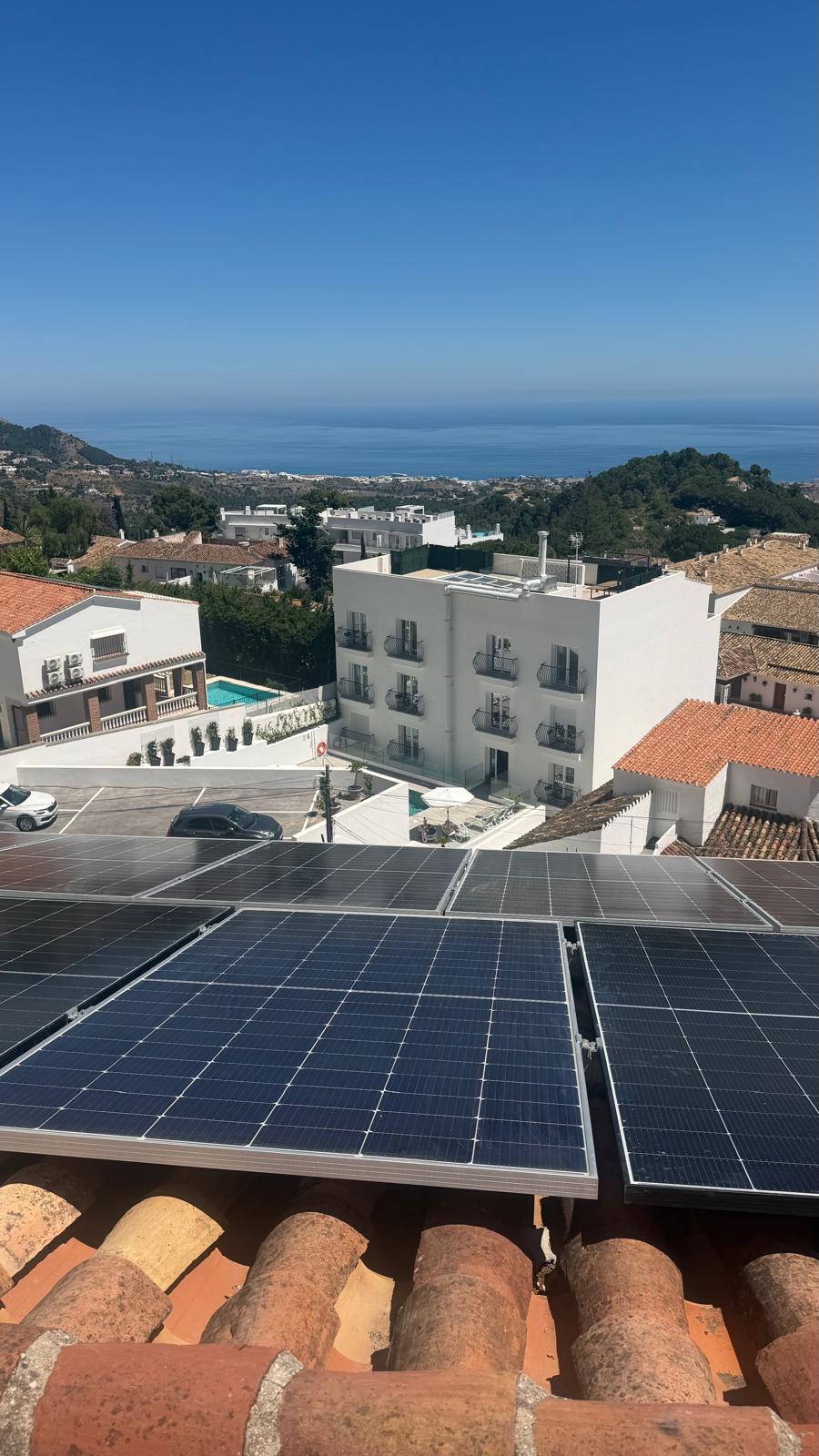
Solar Panels Rescued in Mijas — Wind Damage Emergency & Proper Reinstallation
Panels safe & properly reinstalled
Villa Solar + Battery - Marbella
See the installation scope and equipment below; no financial outcome is promised.
Off-Grid Solar System - Estepona Hills
See the installation scope and equipment below; no financial outcome is promised.